


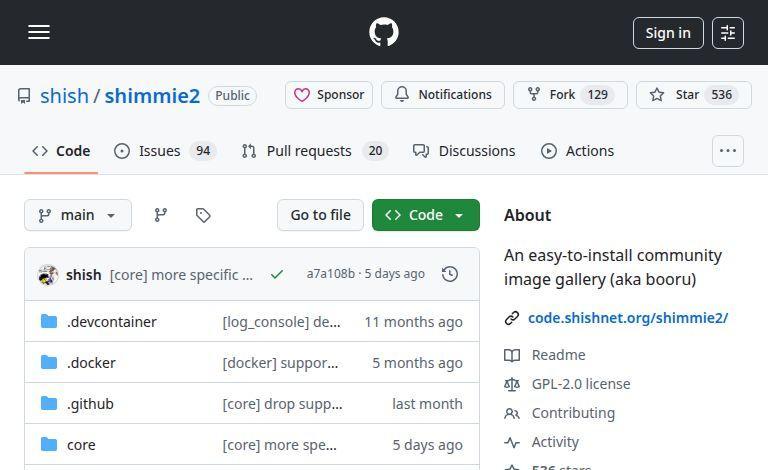
I can’t remember the last time I was as confused while reviewing as I was this time. Unlike most of the other sites that are clear, this one was a lot harder to begin with because I had no idea what I was dealing with. The only thing I saw was some code or script on GitHub, and that was about it. There was no extra information, which made me wonder if I was in the right place or not.
Since I couldn’t do a review without knowing what I was looking at, I had to look for info somewhere else. That sucked, right? Anyway, Shimmie seems to be an image board that tries to make things easier. Now, if you ask me what makes it easier, I don’t know. Keep in mind that I only found out what this thing was a minute ago, and I wouldn’t even know that much if it wasn’t for Google.
The real meaning of Shimmie 2 is this: Shimmie is a Danbooru-style image board, but it’s designed to be much easier to install and run. Okay, now we are getting somewhere. If I’m not mistaken, Danbooru is a site with a vast amount of anime content. I’m talking about animated girls posing, doing things, and who knows what else.
So, after finding out what this thing is, Shimmie 2 is somehow tied to anime. Well, if that’s true, you won’t find any images by just clicking the GitHub link. If I had to guess, you should use that link to get the code to use in a script. That’s the best answer I have.
Instructions
Usually, I would know what to do without even looking at the instructions, but I had to admit that I needed to check the documentation to figure out how this thing works.
The first file explains where and how to install Shimmie2. The file is called “Install straight on disk,” and I think the name is pretty straightforward. You must install this directly on the disk where the site is located. Well, that’s what I got from that file.
You’ll also find requirements. The entire file consisted of only about 10 lines of text, making it easy to understand. It’s easy to install this device, but you need to understand what it is and what it does first. Until I figured that out, I had no idea what I was about to see. You could have told me that this place was filled with flying monkeys, and I would have believed you because that’s how much I knew about Shimmie before.
You don’t always have to install Shimmie on your disk. I suppose you can also install it in a Docker container, if that’s what you mean. That’s the following document, and if you open it, you’ll see a lot. There’s a short explanation, and if you scroll down, you’ll find a script. Now, please don’t ask me what this script does, but I guess it runs with an external database. That will probably mean more to you than to me.
Upgrades
Everything needs an upgrade when the time comes, and Shimmie is no different. When you reach that point, you will have all the necessary documents to complete the process correctly.
In this case, it depends on whether you obtain Shimmie from Git or from a .zip file. You have different instructions for these two. It’s just one sentence, so it seems like anyone can do it. There would be more info if it were a complex process.
Updating the database is also part of upgrading, and it should happen automatically, or at least that’s what the site says. I’m just telling you what I saw. I wish I had more info, but I didn’t care too much about this, so I didn’t look into it more.
Configuration
Everything needs some setup, and so does Shimmie 2. Once you set up everything that’s required, you’ll start with the basic settings. The good thing is that there’s a file that tells you everything you should know.
First, there are general settings. You start with the site title, then go to the front page, main page, and so on. You know how it goes. These are just the basics, so once you’re done, you can proceed to the next steps.
Since Shimmie is all about images, the next thing you should set is the image options. Now, this part I didn’t understand because I didn’t have experience with this kind of setup. Here’s what I saw: $id, $hash_ab, $Tags, $size, and other things. People who aren’t good with coding might have no clue what these things mean, and that’s pretty much me. Although explanations were provided next to each of these items, I remained confused.
These were just the basic settings. The next thing is advanced setup. Interestingly, there are significantly fewer instructions for this part. Are the advanced settings faster and easier to use than the basic ones? Anyway, this file has two scripts that should be used for exceptional cases. It depends on what you want to do.
Development Info
One of the most important things is having a good theme for your site. Pay close attention to this part, as choosing the wrong theme could deter potential customers. I get mad when I find a site with a bad theme, so I understand why this step is essential.
You’ll find a lengthy, detailed explanation in this file, along with a couple of scripts to assist with various tasks. I’m starting to feel like everything runs on scripts, which isn’t a surprise. With coding, you need scripts for everything, so I don’t know why I thought it would be different this time.
This was the longest file, so I guess it’s the most important one. It might not be, but I can see that they added many scripts in this step, so you shouldn’t ignore it. If you mess up the theme, not many people will stay on your site.
Find Help for Issues
There’s a big chance you’ll face problems along the way. Whenever something needs coding, problems will happen. You can’t always get it right the first time, or at least that’s what I’ve heard.
If you encounter any issues, you can find help on GitHub.comGitHub at GitHub.com. They have the “issues” section full of info. You can identify the issue, and if you have the same problem, you may receive a solution right away. If not, you can always post a new problem and wait for a reply.
From what I’ve seen, most issues have solutions, so it’s best to seek help along the way. Of course, some problems still lack solutions because they may be new or have gone unaddressed.
Step-by-Step Instructions to Use Shimmie 2
Even though I didn’t know what Shimmie was at first, I figured it out with the help of Google. This is a Danbooru-style image board, but please note that you won’t find any images on GitHub. This guide provides instructions on using Shimmie 2 and serves as a resource for assistance with any issues you may encounter.
Now, I might not be an expert in coding, but from what I’ve seen, you’ll get enough instructions to make it work. There are several files with all the info you need to use Shimmie, so if that’s what you want, you’ll get all the help from GitHub. You’ll also get help with any bugs. There’s a whole section on the site filled with past issues and solutions. If you don’t find what you need, you can always post your own issue and wait for a reply.
